How Reaction Time Affects Where the Arrow Hits
By Eric Newman April 16, 2026
Introduction
When an animal reacts to a shot, it can move before the arrow arrives.
This can change where the arrow hits.
This test looks at how reaction timing affects impact.
What Was Tested
Two arrows were tested:
379-grain arrow
629-grain arrow
Testing was conducted at 30 yards using a controlled shooting system and a free-fall target to simulate reaction timing while ensuring consistent, repeatable results.
Heavier arrows typically result in slower speeds. In this test, the slower speed increased the effect of reaction timing by placing the arrow farther from the target when the reaction occurred.
What Happens in Real Life
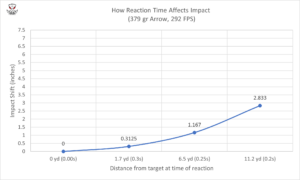
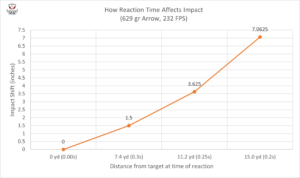
These charts show where the arrow is when the target reacts and how much the impact changes.
As reaction time decreases (for example, from 0.3 seconds to 0.2 seconds), the arrow is farther from the target at the moment of reaction. This increases the change in impact.
Key Point:
The farther the arrow is from the target when it reacts, the more the impact can change.
Comparing the Arrows
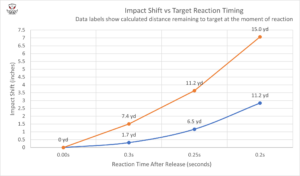
To compare the arrows directly, the reaction time must be the same.
This chart shows both arrows at the same reaction times.
Key Point:
The difference between arrows is small compared to the effect of reaction timing.
Conclusion
Reaction timing has a greater effect on impact than the differences between the arrows tested.
Small differences in reaction time can cause large changes in where the arrow hits.
While arrow weight affects speed, in this test, the effect of reaction timing was much greater than the differences between the arrows.
Test Setup
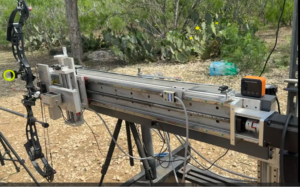
HELIOS Archery Accuracy Test System (H.A.A.T.S.)
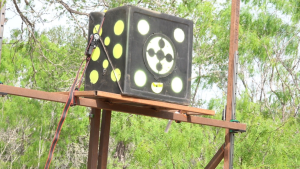
Target mounted on a free-fall drop system used to simulate reaction timing.