
Introduction
In archery discussions, small differences in arrow flight time are often described as insignificant. Because these differences are measured in hundredths or tenths of a second, they are commonly dismissed as being too small to meaningfully affect impact location on a reacting target.
However, projectile-target interactions are highly sensitive to timing. Even small increases in available movement time prior to impact can produce measurable changes in impact location.
This study examines how target reaction timing affects arrow impact using controlled drop testing. Rather than estimating or theorizing movement, this study measures actual impact shift produced by small changes in reaction timing after sound arrival.
Sound Arrival and Reaction Timing
A target cannot react to the shot until sound reaches the target. At 30 yards, sound reaches the target in approximately 0.08 seconds under standard atmospheric conditions.
Reaction timing in this study was therefore defined relative to sound arrival rather than total time after the shot.
Reaction timing after sound arrival:
- 0.12 seconds (120ms)
- 0.17 seconds (170ms)
- 0.22 seconds (220ms)
These timings represent controlled target-release intervals after sound would reasonably reach the target.
Experimental Method
Testing was conducted using HELIOS, a PLC-controlled automated archery testing system designed to eliminate human variation and produce repeatable timing conditions.
Two arrow configurations were tested:
- 379 grain arrow
- Approximately 291.5 fps at the bow
- 30-yard time of flight: approximately 0.319 seconds
- 629 grain arrow
- Approximately 230.3 fps at the bow
- 30-yard time of flight: approximately 0.399 seconds
Velocity and time-of-flight data were obtained using Labradar measurements.
A controlled drop system initiated target movement at predefined times after sound arrival. Impact shift was measured relative to a stationary baseline.
Results
Figure 1 compares the measured impact shift for both arrow configurations under identical reaction timings after sound arrival.
Figure 1. Impact Shift vs. Target Reaction Timing After Sound Arrival
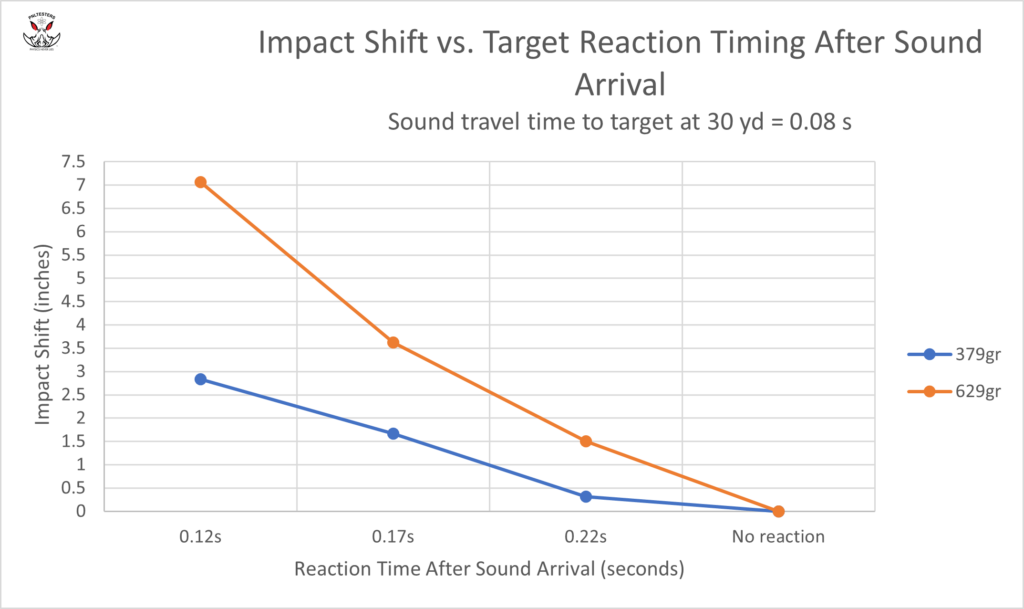
The results show that reducing the time between sound arrival and impact substantially increased measured impact shift.
For the 379 grain arrow:
- 0.12 s reaction: approximately 2.83 inches
- 0.17 s reaction: approximately 1.67 inches
- 0.22 s reaction: approximately 0.31 inches
For the 629 grain arrow:
- 0.12 s reaction: approximately 7.06 inches
- 0.17 s reaction: approximately 3.63 inches
- 0.22 s reaction: approximately 1.5 inches
Why Milliseconds Matter
One of the most important findings of this study is how sensitive the impact location is to very small timing changes.
The difference between:
- 0.22 seconds and 0.17 seconds
- 0.17 seconds and 0.12 seconds
is only 0.05 seconds, or 50 milliseconds.
Despite these extremely small timing intervals, the measured impact shift changed substantially for both arrow configurations.
This demonstrates that projectile-target interactions are highly sensitive to time. Even timing differences measured in milliseconds can significantly alter the impact location when target movement occurs before impact.
Because of this sensitivity, differences in arrow flight time measured in tenths or hundredths of a second cannot automatically be considered insignificant. The physical effect depends on how much additional movement time becomes available prior to impact.
Discussion
This study does not attempt to predict exact animal behavior or claim that every target reacts identically. Instead, it isolates timing as a controlled physical variable and measures how the impact location changes as available movement time increases.
The results show that small increases in available movement time can rapidly increase target displacement prior to impact.
This becomes especially important when discussing differences in arrow flight time between projectile configurations. While tenths of a second may appear small from a human perception standpoint, the measured data demonstrates that these timing differences can produce meaningful changes in impact location.
Conclusion
Target movement prior to impact is governed by available movement time after reaction begins.
This study demonstrates that even small timing differences measured in milliseconds can substantially affect impact location. Controlled testing showed measurable increases in impact shift from timing changes of only 0.05 seconds.
These findings demonstrate that projectile-target interactions are highly sensitive to timing and that small increases in arrow flight time can meaningfully increase the opportunity for target movement prior to impact.