
PNL TEST STANDARD
PNL-TS-001 REV 2.2
Date: 05/07/2026
Author: PNL Testers
1. Scope
1.1 This standard establishes a repeatable method for measuring the edge sharpness of archery broadheads using the Edge-On-Up PT50A BESS Sharpness Tester.
1.2 This method applies to:
• Fixed blade broadheads
• Replaceable blade broadheads
• Single-bevel and double-bevel edges
1.3 Results are reported in grams-force (gf) using BESS methodology.
1.4 This standard is intended to improve repeatability and consistency in broadhead sharpness testing by defining:
• Test locations
• Number of trials
• Blade preparation
• Reporting requirements
1.5 This standard does not replace or modify the manufacturer’s operating instructions for the PT50A tester.
2. Referenced Documents
2.1 Edge-On-Up PT50A manufacturer documentation.
2.2 BESS (Brubacher Edge Sharpness Scale) methodology references.
3. Purpose
3.1 The purpose of this standard is to:
• Provide a consistent method for broadhead sharpness testing
• Reduce variability between tests
• Establish a repeatable baseline for comparison across broadhead designs
• Standardize testing procedures specific to archery broadheads
4. Terminology
4.1 Sharpness (BESS Value): Force, in grams-force, required to sever standardized test media.
4.2 Cut Event: The moment at which the test media is completely severed.
4.3 Peak Force: The maximum displayed force immediately prior to filament failure.
4.4 Usable Cutting Edge Length: The continuous sharpened portion of the blade intended for cutting.
5. Significance and Use
5.1 This method provides a quantitative measurement of broadhead edge sharpness.
5.2 Results may be used to:
• Compare broadhead sharpness
• Evaluate manufacturing consistency
• Measure edge retention after use
• Compare sharpening methods
5.3 Sharpness is only one factor in broadhead cutting performance and shall not be interpreted as a complete measure of penetration performance.
6. Apparatus
6.1 Edge Sharpness Tester: Edge-On-Up PT50A BESS Sharpness Tester or equivalent manufacturer-configured PT50A system.
6.2 Blade Fixture: Rigid fixture or holding method capable of preventing movement during testing.
6.3 Test Media: Standard BESS test filament or manufacturer-approved equivalent.
7. Test Specimen Preparation
7.1 Broadheads shall be clean and free of debris.
7.2 Blades shall be tested in as-received condition unless otherwise specified.
7.3 Each cutting edge shall be tested independently.
7.4 If sharpening is performed prior to testing, the sharpening method shall be documented.
8. Test Procedure
8.1 Secure the broadhead to prevent movement during testing.
8.2 Position the filament perpendicular to the cutting edge unless otherwise specified by the manufacturer.
8.3 Operate the PT50A in accordance with manufacturer instructions.
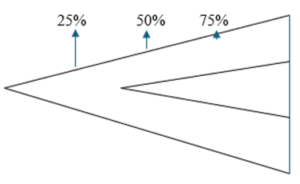
8.4 Each cutting edge shall be tested at normalized positions corresponding to 25%, 50%, and 75% of the usable cutting edge length (See Fig. 1).
8.4.1 Broadhead edges may exhibit localized variations in sharpness due to manufacturing tolerances, sharpening processes, coating thickness, or edge damage. Testing at multiple normalized locations provides a more representative assessment of sharpness consistency across the edge than testing at a single location.
FIG. 1 — Normalized Broadhead Sharpness Test Locations (25%, 50%, and 75% of Usable Cutting Edge Length)
8.5 One trial shall be performed at each location, for a minimum of three (3) trials per cutting edge.
8.6 Replace or reposition test media as required to ensure each trial uses an undamaged section.
8.7 Record the displayed peak force value for each trial.
9. Data Collection
9.1 Record the following for each trial:
• Blade identification
• Test location
• Individual sharpness value (gf)
9.2 Any trial showing obvious blade movement, media slip, or abnormal filament failure shall be rejected and repeated.
10. Calculation
10.1 For each blade or edge, calculate:
• Mean sharpness (gf)
• Minimum value
• Maximum value
• Standard deviation when practical
10.2 Individual trial values should be retained when practical.
11. Broadhead Sharpness Classification Scale (Reference Only)
| Sharpness (gf) | Classification | Performance Description |
| 0–150 | Extremely Sharp | Razor-level edge; shaves arm hair easily |
| 150–250 | High Performance | Excellent cutting ability; hunting ready |
| 250–300 | Acceptable | Functional edge; shaving ability begins to decline |
| 300–400 | Reduced Hunting Performance | Sharpening recommended before use |
| >400 | Very Dull | Sharpening required before use |
© 2026 PNL Testers. All rights reserved.